Home>>Shale-Gas Resources
Selected Shale-Gas Resources

Maps and Stratigraphy:
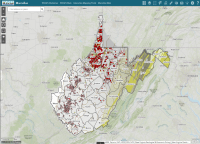
Selected map data are updated weekly;
specifically, Completed/Permitted Marcellus Wells and
Wells through top of Onondaga/equivalents with Digitized/Scanned Well Logs.
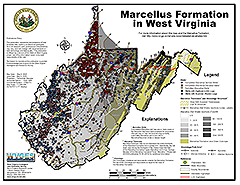
Data through 5/5/2023. This map is a layered, interactive PDF! Although you can view the PDF in a web browser, you will need Adobe Acrobat or the free Adobe Reader to turn on/off the individual layers.
Revised stratigraphic terminology for some Upper Devonian units.
Correlation of Devonian Units

Marcellus Data Files:
Downloadable Files
Downloadable files associated with Marcellus/Marcellus Interactive Map.
Marcellus Shale Wells - Completed, Permitted and Cancelled Episodes - Updated Daily
(Last updated Friday, October 9, 2026)
Download the Excel Workbook: WVGES Marcellus Wells.xlsx 
~4.0 MB
Description:
This Excel workbook contains six spreadsheets with information about horizontal and vertical wells drilled to or through the Devonian Marcellus Shale in West Virginia. Sheets 1 through 4 contain a description of the data fields and the completed, permitted, and cancelled well files, respectively. The sheet of completed well data also contains annual gas and/or oil well production data as reported by operators since 2005, in addition to natural gas liquids since 2013. Vertical wells contain commingled production if zones in addition to the Marcellus have been completed. Sheets 5 and 6 have a description of the records and the data, respectively, with monthly well production data for gas, oil, and natural gas liquids. Well locations are in decimal degrees and UTM coordinates (NAD83, UTM Zone 17 north) for users who wish to create their own GIS shapefiles from the data.
Well Logs - Deep Wells (data through July 30, 2025)

Download Excel File, Scanned (Raster) Logs: WVGESScannedLogsOnondagaAndDeeper_07302025.xlsx 1,700 KB
Download Excel File, Digitized (LAS) Logs: WVGESDigitizedLogsOnondagaAndDeeper_07302025.xlsx 107 KB
Description:
Each Excel file contains a list of wells penetrating the top of the Onondaga Limestone/equivalent or deeper for which WVGES has scanned or digitized logs. The Marcellus may or may not be present or
recorded on the log. An unconformity exists between the younger Rhinestreet black shale and the Onondaga Limestone in portions of Cabell, Mason, McDowell, Mingo, and Wayne counties; the Marcellus is
thought to be missing in these areas (see Marcellus thickness map in Marcellus Interactive Map or downloadable Marcellus thickness files). Individual logs for the Onondaga/equivalent and deeper are
available for free downloading through the interactive map application and
at
https://www.wvgs.wvnet.edu/pipe2/FileRepository.aspx;
the associated well data are available on our online
"pipeline" data application
at
https://www.wvgs.wvnet.edu/oginfo/pipeline/pipeline2.asp.
Marcellus Thickness, Questionable Data Area, and Outcrop GIS Shapefiles and Additional Information
Top of Onondaga (~Base of Marcellus) Structure Contour, Fold, and Fault GIS Shapefiles and Metadata
Download:
Spatial Reference Properties: Projection=Transverse Mercator; Geographic Coordinate System=GCS North American 1983. A .prj file with more details is bundled with .zip files.
Horizontal Wells:
Download the Excel Workbook: WVGES Horizontal Wells.xlsx , (824 KB)
Updated:
Friday, October 9, 2026
This Excel workbook contains data on horizontal wells drilled in West Virginia.
The first spreadsheet in the workbook is a description of the data fields contained in the following two sheets: "Completed Horizontal Wells" and "Permitted Horizontal Wells". While most of the records in these files represent horizontal completions or planned horizontal completions in the Marcellus and Lower Huron shales, more than 17 other formations are also represented here.
Note: ''Operator Name'' is the operator who drilled the well or owned the well at time of completion. This may or may not be the same operator who reported production for the well, as the well may have been sold after it was completed. In the data sheets, zeroes represent values submitted by the operator as zero values, whereas blank (null) fields were not reported or submitted. The spreadsheet data are refreshed weekly to reflect updates added by staff to the database during the week. Latitudinal and longitudinal values and UTM coordinates (for NAD 83, UTM zone 17 north) for the surface location of the vertical bore are included in the well data.
Publications, Presentations, and Other References:
◊ West Virginia Geological and Economic Survey (WVGES)
-
WVGES Marcellus Shale and Utica-Point Pleasant Summaries:
Previous:
-
2023
 ,
2022
,
2021
,
2020
,
2019
,
2018
,
2017
,
2016
,
2015
,
2014
,
2013
,
2012 (Marcellus only)
,
2022
,
2021
,
2020
,
2019
,
2018
,
2017
,
2016
,
2015
,
2014
,
2013
,
2012 (Marcellus only)
-
WVGES Reports (newer):
-
2021, Pool, Susan E., Boswell, Ray M., Saucer, John T., and Carney, B.J., Estimates of Natural Gas Resources and Recovery Efficiencies Associated with Marcellus Development in Northern West
Virginia: West Virginia Geological & Economic Survey, Reports of
Investigation RI-36. RI-36: Web Page with Report
-
2018, Boswell, Ray M. and Pool, Susan E., Lithostratigraphy of Middle and Upper Devonian Organic-Rich Shales in West Virginia: West Virginia Geological & Economic Survey, Reports of
Investigation RI-35. RI-35: Web Page with Report, Cross-Sections, Interactive Map, and Data Spreadsheet
-
2013, Pool, Susan E., A Preliminary Natural Gas Resource Assessment of the Marcellus Shale for West Virginia using Basic Geologic Data and GIS: West Virginia Geological & Economic Survey,
Open File Report OF 1305. OF1305: Report
(PDF, ~4 MB)
-
WVGES Presentations and Posters
2013 to present are on our Posters and Presentations page.
Older WVGES Presentations and Reports:
- 2008 (somewhat dated: before horizontal drilling) WVGES Presentation: Geology of the Marcellus Shale,
WVGES_GeologyMarcellusShale.pdf (PDF, 1.13 MB)
- 2008 WVGES Poster for ES-AAPG Meeting: New Interest in Cores Taken Thirty Years Ago: the Devonian Marcellus
Shale in Northern West Virginia— Katharine Lee Avary (WVGES) and Eric Lewis (WVGES):
WV_Cores_Avary_Lewis_2008.pdf (PDF, 2.72 MB)
-
Two chapters in the 1996 Atlas of Major Appalachian Gas Plays (John B. Roen and Brian J. Walker, editors, 1996, WVGES Volume 25) address Devonian shales. The chapter on Upper Devonian black shales includes a discussion of the Marcellus Shale, the deepest of the Devonian organic-rich shales in West Virginia. A chapter on Upper Devonian fractured black and gray shales and siltstones addresses the more eastern and northern of the shales in the state. This publication is
available from the WVGES publications sales office. See Atlas of Major Appalachian Gas Plays for the publication description. Please click here for a PDF of our publications order form , or call Pub Sales at (304) 594-2331 to order a copy.
◊ US Department of Energy (DOE)
- U.S. DOE Report (2013): Modern Shale Gas Development in the United States: An Update,
shale-gas-primer-update-2013.pdf (PDF, 12.59 MB).
- U.S. DOE Report (2010): Projecting the Economic Impact of Marcellus Shale Gas Development in West Virginia: A Preliminary Analysis Using Publicly Available Data, ALL-DOE_WV_MarcellusEconomics2010.pdf (PDF, 2.22 MB).
 U.S. DOE (2007): Archive of Unconventional Gas Resources Program or Natural Gas Program Archive, a compendium of pioneering research over two decades (1976 to 1995) by the Department of Energy's National Energy Technology Laboratory (DOE/NETL) funded by the U.S. DOE and the Gas Research Institute (GRI) (now the Gas Technology Institute [GTI]). This archive includes nearly 1,500 valuable documents scanned and available in two compressed (.zip) files. The first file ('Disk 1')
  contains reports and logs related to the Eastern U.S. Gas Shales Program (1976-1992). Much of the earlier work emphasized the Lower Huron shale, the primary productive zone in the historic productive area (e.g., the Big Sandy field of southwestern West Virginia and eastern Kentucky).The second file ('Disk 2') combines program information related to Western U.S. Gas Sands (1977-1992), Methane Recovery from Coalbeds (1978-1982), Methane Hydrates Program (1982-1992), Deep Source Gas Project (1982-1992), and Secondary Gas Recovery (1987-1995). Both include a comprehensive summary of the Unconventional Gas Resources Program and an extensive bibliography dedicated to each of these programs. This archive was originally published as a 12 CD set and then as a 2 DVD set before being available for direct download from DOE from this CD/DVD Retrieval page.
◊ US Geological Survey (USGS)
- 2011, Coleman, J.L., Milici, R.C., Cook, T.A., Charpentier, R.R., Kirschbaum, Mark, Klett, T.R., Pollastro, R.M., and Schenk, C.J., Assessment of Undiscovered Oil and Gas Resources of the Devonian Marcellus Shale of the Appalachian Basin Province, USGS Fact Sheet 2011-3092, 2p., pubs.usgs.gov/fs/2011/3092/.
- 2006, Milici, R.C. and C.S. Swezey, Assessment of Appalachian Basin Oil and Gas Resources: Devonian Shale—Middle and Upper Paleozoic Total Petroleum System, USGS Open-File Report 2006-1237, pubs.usgs.gov/of/2006/1237/.
- 2005, Repetski, J.E., R.T. Ryder, K.L. Avary, and M.H. Trippi, Thermal Maturity Patterns (CAI and %Ro) in the Ordovician and Devonian Rocks of the Appalachian Basin in West Virginia, USGS Open-file Report 2005-1078, pubs.usgs.gov/of/2005/1078/.
- 1993, Petroleum Geology of the Devonian and Mississippian Black Shale of Eastern North America, USGS Bulletin 1909, J.B. Roen and R. C. Kepferle, editors: pubs.er.usgs.gov/usgspubs/b/b1909.
A portion of this work was supported in part by RDS Agreement 41817M4160 and the U.S. Department of Energy Contract DE-AC26-04NT41817.630.01.14.
Page last revised July 30, 2025.
Please send web site questions, comments, or suggestions to
webmaster.

WV Geological & Economic Survey
1 Mont Chateau Road
Morgantown, WV 26508
Phone: (304) 594-2331
Fax: (304) 594-2575
info@wvgs.wvnet.edu





 WV Geological & Economic Survey