PETROGRAPHY OF THE TRENTON AND BLACK RIVER GROUP CARBONATE ROCKS IN THE APPALACHIAN BASIN
Christopher D. Laughrey - Pennsylvania Geological Survey
Jaime Kostelnik - Pennsylvania Geological Survey
INTRODUCTION
Carbonate petrography is the study of limestones, dolostones,
and associated rocks by optical and electron microscopy (Scholle and Ulmer-Scholle,
2003). Our purpose in the petrographic portion of this study is 1) to enhance
field studies and core descriptions of Trenton and Black River Group carbonate
rocks in the Appalachian basin, 2) to interpret the diagenetic history of
these rocks, particularly with regard to its effects on porosity and permeability,
and 3) to provide a frame of reference for the geochemical data and interpretations
presented elsewhere in this study.
Petrographic data enhance field and core descriptions of carbonate
rocks through the identification of constituent grains, matrix, and depositional
texture. This data enable us to develop detailed classifications of the reservoir
rocks and interpret their depositional setting.
Interpretations of the diagenetic history of the Trenton and
Black River carbonates provides us with a sense of the comparative timing
of significant diagenetic events such as cementation or secondary porosity
development relative to the emplacement of hydrocarbons in the reservoirs.
Such interpretations are particularly critical for understanding Trenton and
Black River reservoirs. Cambro-Ordovician carbonate reservoirs worldwide are
dominated by meter-scale peritidal, mud-dominated cycles and thin-bedded,
heterogeneous layering; the only buildups are thrombolitic or microbial, and
reservoir quality is controlled by fracturing, dolomitization, and karst development
beneath the top-Saulk unconformity (Markello, 2005). The Trenton and Black
River Groups consist of remarkably tight carbonate rocks that were completely
lithified throughout the basin during marine and burial diagenesis. Reservoirs
only occur where fracturing and dolomitization created adequate storage capacity
for commercial hydrocarbon accumulations.
Petrography provides a frame of reference for the geochemical
data we use to understand the dolomitization processes that yielded the most
important petroleum reservoirs in the Trenton and Black River Groups in the
Appalachian basin. The geochemical data include stable carbon and oxygen isotopes,
fluid inclusions,
87Sr/
86Sr ratios, and trace element
(Fe and Mn) distributions.
The petrographic data presented herein are useful on a broad
scale for documenting the distribution of porous and permeable carbonate rock
facies in the Trenton and Black River Groups in the Appalachian basin. The
data allow us to determine the spatial distribution of reservoir seals, compartmentalization,
and diagenetically controlled pore geometry in the productive gas fields.
to top
METHODS
We collected samples from 17 different cores of Trenton and/or
Black River carbonate rocks recovered from wells throughout the Appalachian
basin. The cores we examined and sampled are listed in Table 1. We described
the cores before sampling, and these descriptions will be integrated into
the pending reports on stratigraphy. We also collected cuttings samples from
one well in Pennsylvania for thin sections, and prepared numerous thin sections
from outcrop samples in Pennsylvania and Kentucky. In all, we analyzed 740
thin sections of Trenton and Black River carbonates. Selected samples were
further studied by scanning electron microscopy and energy-dispersive X-ray
spectroscopy.
We used a Leica DML polarizing microscope equipped with a Leica
DFC camera for all transmitted light microscopy. We examined selected unembedded
and unpolished samples on a Hitachi S-2600N variable pressure scanning electron
microscope (SEM) operating with a pressure of 10 Pascals using the backscattered
electron detection imaging system at 20 kV and a working distance of 15 mm.
The elemental composition of these samples was determined using Quartz Imaging
System's Quartz XOne energy-dispersive X-ray spectroscopy (EDS) package with
a Gresham Sirius 10/UTW/SEM detector having a 10 mm
2 crystal and
an ultra thin polymer window. We used the same SEM operating at 20 kV and
a working distance of 15 mm when conducting EDS analyses.
We classified all carbonate rock samples using the classification
systems of both Dunham (1962) and Folk (1962). We found Dunham's (1962) classification
useful for microfacies analysis when we could use it - it is descriptive,
objective, and easy to use in the field or laboratory, and it conveys some
genetic information. But the Dunham classification fell short in naming many
of the Trenton and Black River limestones and dolostones significantly altered
by diagenesis. In these instances the Folk (1962) classification system provided
us with a useful, objective and descriptive terminology that provided for
grain size, allochem composition, and diagenetic alterations. For these reasons,
we use carbonate names from both systems interchangeably throughout this report.
We classified all dolostones using the classification system of Wright (2001).
We classified carbonate porosity using the systems of both Choquette and Pray
(1970) and Luo and Machel (1995).
to top
CONSTITUENTS
Skeletal Grains
The skeletal constituents of carbonate rocks reflect the distribution
of calcium carbonate-secreting organisms throughout geologic time. Many new
carbonate-secreting marine organisms emerged by Middle Ordovician time, some
450 million years ago, and these are well represented in the composition of
Trenton and Black River rocks. Fragments of brachiopods, bryozoans, crinoids,
corals, trilobites, calcareous algae, and gastropods comprise the principal
skeletal grains in the rocks. The distribution of these organisms in the carbonate
depositional realm was controlled by environmental factors such as water depth,
temperature, salinity, substrate, and turbulence. Thus the correct identification
of these skeletal grain types and their depositional texture is critical for
correct environmental interpretations.
The original mineralogy of the skeletal grains, i.e., aragonite,
low Mg calcite, high Mg calcite, or a mixture of aragonite and calcite, affected
the fate of the skeletal grains during diagenesis. Their susceptibility to
recrystallization, dissolution, and dolomitization was particularly important
to the development of Trenton and Black River carbonate reservoirs in the
subsurface.
Skeletal grains are identified on the basis of their size, shape,
microstructure, and original mineralogy (Tucker and Wright, 1990; Scholle
and Ulmer-Scholle, 2003).
Appendix I provides a comprehensive review and photographic
guide of the major skeletal grains that occur in the Trenton and Black River
rocks of the Appalachian basin.
Non-skeletal Grains
Non-skeletal carbonate grains in the Trenton and Black River
rocks include ooids, peloids, grain aggregates, and clasts.
Appendix I includes a general review and photographic guide of the non-skeletal grains found in
the Trenton and Black River rocks of the Appalachian basin.
Ooids are a type of coated carbonate grain, spherical to sub
spherical in shape, consisting of one or more regular concentric lamellae
around a nucleus. The nucleus is often a carbonate particle, but can be a
non-carbonate clastic particle too. The term ooid is restricted to grains
less than 2 mm in diameter, and most ooids range from 0.2 to 0.5 mm in diameter.
This is the size of fine- to medium- grained sand in the Wentworth scale.
Recent marine ooids exhibit tangential, radial, or random microfabrics. Ancient
marine ooids may have relic tangential microstructures or, more commonly,
radial microfabrics. Many ancient ooids are micritic or display replacement
with neomorphic spar. We only found ooids in portions of the Black River Group.
We did not find any ooids in the Trenton Group rocks that we examined, and
we could not find any report of Trenton ooids in the literature.
While ooids are locally important, peloids are the most diverse
and abundant non-skeletal grains in the limestones and dolostones that we
examined, and their origins are diverse and complex. Indeed, many, if not
most, of the peloids in the Trenton and Black River carbonates may not be
grains at all but cements instead. The original textures of the peloidal limestones
appear to have influenced dolomitization processes and subsequent dolomite
fabrics and porosity distributions in the Trenton and Black River petroleum
reservoirs throughout the Appalachian basin.
Peloids are a type of non-skeletal carbonate particle formed
of cryptocrystalline and microcrystalline calcium carbonate, and/or carbonate
microspar (Scholle and Ulmer-Scholle, 2003, p. 254). Peloids are spherical,
cylindrical, or angular particles composed of aggregated carbonate mud and/or
precipitated calcium carbonate. They exhibit no internal structure. There
is no defined restriction on the size or origin of peloids, thus the term
allows reference to allochems composed of micritic material without implying
their specific origin (McKee and Gutschick, 1969).
Peloids are polygenetic, and identifying their precise origin
is often difficult in carbonate rocks (see discussions by Macintyre, 1985
and Scholle and Ulmer-Scholle, 2003). Some peloids are fecal in origin (carbonate
pellets), while others are grains derived from calcareous algae, micritized
allochems, and reworked mud clasts (Tucker and Wright, 1990; see the examples
presented in
Appendix I). Most peloidal textures in carbonate rocks, however,
probably are chemical in origin, i.e., cements in which the peloids appear
as clots with a flocculent fabric- the
structure grumeleuse of Bathurst
(1975, p. 511 - 513 and Figure 350). These clots are the nucleation sites
of small crystals of high-magnesium calcite (Tucker and Wright, 1990). The
nuclei may be organic, possibly microbial matter (Chafetz, 1986) or simply
sub-microcrystalline, radial, acicular calcite crystals that grew around a
small number of nuclei (Bosak and others, 2004). In either case, the peloids
precipitated
in situ as marine cement on or just below the sea floor
(Tucker and Wright, 1990; Malone and others, 2001; Bosak and others, 2004).
The recent work of Bosak and others (2004) recommends that abiotic mechanisms
should be the null-hypothesis for peloid formation.
Peloidal textures are ubiquitous in the Trenton and Black River
carbonates throughout the Appalachian basin. They occur in all carbonate rock
types and their origins are quite diverse.
Appendix I contains numerous examples
of peloids that clearly are carbonate grains. In many instances, however,
we interpreted peloidal fabrics in Trenton and Black River rocks as cement.
We discuss peloidal cement textures in detail below in the section on diagenesis.
Most of the dolomitized carbonate rocks of Black River age in
the subsurface of west central New York state and north central Pennsylvania
exhibit a precursor peloidal fabric that dominated the limestones there. The
petrophysical character of microporosity in these precursor peloidal limestones
may have been critical in controlling the migration of dolomitizing fluids
through the rocks adjacent to faulted and fractured strata (see Cantrell and
Hagerty, 1999). These peloidal textures also are common in dolomitized limestones
in western Ohio and central Kentucky.
Matrix
Fine-grained matrix in the Trenton and Black River Formations
consists of calcite micrite, microspar, pseudospar, and terrigenous clay minerals.
Micrite is composed of small calcite crystals 1 to 4 m in diameter. These
crystals formed through the breakdown of coarser carbonate grains, such as
calcareous algae, or through inorganic precipitation on the seafloor (Tucker
and Wright, 1990; Scholle and Ulmer-Scholle, 2003). Figure 1 shows several
examples of micrite matrix in the Trenton and Black River Formations. Microspar
consists of calcite crystals 5 to 30 m in diameter. It forms through neomorphic
recrystallization of micrite. Pseudospar also is a recrystallization product
of finer calcite, but it is even coarser than microspar with crystal diameters
of 30 to 50 μm. Clay mineral, predominately illite, mixed-layer illite-chlorite,
and smectite, occur in some Trenton Formation samples, particularly in ramp
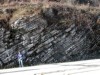
slope carbonates intimately interbedded with terrigenous shales (Figure 2).
Some of the matrix material in the Trenton Formation is organic rich (up to
3.74% total organic carbon), and might be important as a petroleum source
rock.
Other Components (non-authigenic)
In addition to terrigenous clay minerals, non-carbonate sedimentary
components of the Trenton and Black River Formations include detritial quartz
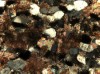
silt and very fine sand, bentonite, and rare glauconite. The quartz entered
the carbonate environments as air-borne and/or water-borne sediment. Very
fine quartz sand and silt dispersed throughout some of the limestones in the
Black River Formation (<1% of the rock) might be air-borne, but was more
likely reworked from very thin fluvial and paralic siliciclastic accumulations
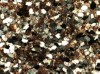
that were deposited on the carbonate ramp during sea level lowstands (Figure
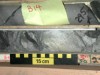
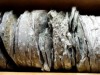
3). The volcaniclastic k-bentonites (Figure 4) are interbedded with the carbonates,
and were rapidly deposited below storm wave base by volcanism along the island
arc that formed along the southeastern Laurentian continental margin during
the Taconic orogeny (Thompson, 1999). Reworked fragments of these k-bentonites
occur in some of the limestones.
to top
MICROFACIES AND DEPOSITIONAL ENVIRONMENTS
All of the principal carbonate rock types occur in the Trenton
and Black River Formations of the Appalachian basin. The depositional texture
of the original limestones correlate directly to the sedimentary environments
of the carbonate ramp on which the various rock types accumulated. Tidal flat
and lagoonal limestones mostly consist of mudstone and wackestone, with thin
packstone/grainstone deposits that collected within tidal channels. These
rocks were deposited in peritidal settings as low-energy, shallowing-upward
successions and thick lagoonal successions. Although less common, some grainstones
and packstones accumulated as high-energy shallowing upward successions deposited
as beach carbonates in the peritidal settings too.
Subtidal deposits include boundstones, grainstones, packstones,
wackestones, and mudstones deposited in both shallow and deeper carbonate
ramp setting. Rocks that formed above wave base on the shallow ramp include
hardground-bounded, amalgamated grainstone, and grainstone-capped high energy
shoaling successions. Skeletal packstone/wackestone - mudstone successions,
also bound by well-developed hardgrounds, formed on the deeper ramp below
fair-weather wavebase. Graded carbonate beds - tempestites and turbidites
- accumulated in slope and basin margin environments. These consist of upward-fining
grainstone/packstone and wackestone/mudstone couplets separated by siliciclastic
shales. The carbonate materials were introduced from the carbonate ramp, while
the shales came from the Taconic highlands and volcanic arc along the southeast
margin of Laurentia (Pope and Steffens, 2003).
to top
DIAGENESIS
The term diagenesis refers to all of the processes that affect
sediment from just after deposition up to the lowest grade of metamorphism,
the greenschist facies (Pettijohn and others, 1987). It is the sum of physical,
chemical, and biochemical changes occurring in a sedimentary deposit after
its initial accumulation, excluding metamorphism (Friedman and Saunders, 1978).
Diagenesis in the rocks of the Trenton and Black River Groups included seven
major processes: 1) microbial micritization; 2) cementation; 3) neomorphism;
4) replacement; 5) physical and chemical compaction; 6) dissolution; and 7)
dolomitization (see, Tucker and Wright, 1990, p.314). Dolomitization is the
most important diagenetic aspect of the Trenton and Black River petroleum
reservoirs and is discussed separately in the next section of this report.
Note: The term diagenesis is used differently by
organic geochemists, and we employ their usage in the petroleum geochemistry
reports of this research. In petroleum geochemistry, diagenesis is the process
involving the biological, physical, and chemical alteration of the organic
debris in sediments without a pronounced effect from rising temperature (Hunt,
1996). It covers the range of temperature up to about 50°C (122°F).
Readers should bear these different usages in mind when reading this report.
Microbial Micritization
Partial to complete microbial micritization of skeletal grains,
ooids, and probable pellets occurs in most carbonate rock types in the Trenton
and Black River Groups throughout the Appalachian basin. Microbial micritization
is most evident in bioclastic grainstones and packstones where micrite envelops
developed on skeletal grains, and in some mixed oolitic/peloidal grainstones
and packstones where the peloids show compelling evidence of carbonate grain
degradation and replacement with micrite. In both cases, the micritization
process may have been mediated by endolithic algae, fungi, or bacteria and
associated biochemical or physiochemical processes.
The micrite envelops shown in
Appendix
II (Micritization Examples
#1 - 4) formed around many of the bioclasts in mixed-fossil grainstones. These
envelopes are essentially identical to those shown and discussed by Milliman
(1974), Bathurst (1975), Tucker and Wright (1990), and Scholle and Ulmer-Scholle
(2003). Bathurst (1975, p.381 - 389) suggested such envelopes formed through
the filling of altered grains rather than precipitation of a new rind around
the grain: algae, fungi, or bacteria bore into the grain, die, and the subsequent
alteration of the organic material provides a chemical environment conducive
to calcium carbonate precipitation, thus filling the voids.
Intense activity by endolithic microbes can lead to complete
micritization of carbonate grains. This was relatively common during deposition
of both Trenton and Black River carbonates. (
Figure
5) shows wholly micritized ooids in the Black River Formation in the subsurface
of western New York.
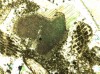
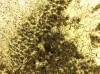
The micrite envelope surrounding the echinoid fragment in Figure
6 originated in the same way as those shown
Appendix
II, i.e., through marine
cementation within spaces created by endolithic boring organisms. The micrite
cement shown in Figure 6, however, displays a distinctive clotted or peloidal
texture Figure (
6b
and
6c).
Higher magnification (
Figure
6c) reveals that the "clots" of microcrystalline calcite in the micrite
rind consist of unimodal, decimicron-size spherical clusters composed of even
smaller (micron- and sub micron-size) calcite crystals. Each clot or peloid
consists of a brownish, cloudy nucleus and a rim of clear, well-developed
euhedral crystals. These clots grade into adjacent patches of coarser, centimicron-size
microcrystalline matrix with an identical peloidal fabric or into coarser
calcite spar cement. These micrite envelopes and contiguous patches of clotted
microcrystalline calcite may be bacterially induced calcite precipitates,
or strictly abiotic cement (Lighty, 1985; Macintyre, 1985; Chafetz, 1986;
Tucker and Wright, 1990; Scholle and Ulmer-Scholle, 2003; Bosak and others,
2004).
Cementation
The precipitation of calcium carbonate cements in the Trenton
and Black River limestones was a major diagenetic process during and shortly
after deposition on the sea floor in Ordovician time. Burial cementation also
affected the rocks. The principal calcite cements in the rocks are 1) peloidal
calcite, 2) prismatic fibrous to bladed calcite rinds on allochems, 3) meniscus
calcite cement, 4) syntaxial calcite overgrowths, and 5) calcite spar. Dolomite
cements are important, but we discuss these later in the section on dolomite
textures. Several late-stage non-carbonate cements are associated with dolomite
cements and we discuss these in the section on dolomitization.
Peloidal Cements
While microbial micrite envelopes around allochems and micrite
replacement of grains are common in the Trenton and Black River carbonates
of the Appalachian basin, most of the microcrystalline calcite, microspar,
and pseudospar in these rocks occur as matrix in packstones, wackestones,
and mudstones. As discussed above, much of this matrix originally formed in
situ as carbonate mud derived from the breakdown of organisms, and it now
exists in the rocks as neomorphic, recrystallized calcite. A great deal of
the carbonate matrix in all of the limestone types, however, also formed in
situ as peloidal cement. The clotted fabric of peloidal cement is ubiquitous
in the Trenton and Black River limestones, and can usually be discerned even
through most dolomite fabrics.
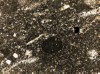
Figure 7 shows core and thin section photographs of Black River
Formation limestone recovered in the Gray #1 well core, Steuben County, NY.
Figure
7a shows the macroscopic appearance of this limestone - a seeming medium
gray, bioturbated and burrowed sparse biomicrite (Folk, 1962) or wackestone
(Dunham, 1962). There are problems with using the Dunham (1962) classification
for this sample (see discussion below) so we prefer the Folk (1962) name.
Dissolution structures (solution seams) indicate moderate chemical compaction.
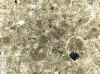
Thin section examination of this sample reveals that skeletal
grains comprise about 20 percent of the limestone, and include crinoids, bryozoans,
brachiopods, trilobites, alga, and gastropods (
Figure
7b). Most allochems were altered by neomorphism, specifically recrystallization
and degrading recrystallization. Authigenic pyrite, quartz, feldspar, and
anhydrite along with dolomite make up about 5.5 percent of the rock. About
75 percent of this limestone, however, consists of decimicron-size peloids
that could be interpreted as either framework grains or cement (Scholle and
Ulmer-Scholle, 2003;
Figure
7b). If framework grains, then the peloids might have originated as 1)
algal material, 2) detritial sediment, 3) pellets, or 4) a replacement of
other framework grains (Tucker and Wright, 1990, p.321 and references therein).
If the peloids are cement then they are
in situ precipitates.
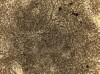
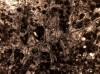
Careful examination of the peloids at higher magnifications
(Figure
7c
and
7d)
reveals that they most probably are cement and not carbonate grains. Individual
peloids are 50 to 100 μm in diameter and consist of 1) a dark brown nucleus
composed of micron-size calcite surrounded by 2) a rim of euhedral, dentate
to blocky microspar. The average crystal size of the later is ~25μm. The
highest magnification view (
Figure
7d) shows the nuclei consist of clots of submicron-size opaque material;
this material might be organic, possibly microbial matter (Chafetz, 1986)
or simply submicrocrystalline, radial, acicular calcite crystals that grew
around a small number of nuclei (Bosak and others, 2004). If the nuclei are
organic, the peloids likely originated as
in situ precipitates around
clumps of bacteria and the microspar likely is a neomorphic recrystallization
product of earlier micrite matrix (Lighty, 1985; Macintyre, 1985; Chafetz,
1986; Tucker and Wright, 1990). If the nuclei are inorganic, the opaque appearance
of the peloids probably is a consequence of the small crystal grain size relative
to the thickness of the thin section (Bosak and others, 2004). In this case,
the peloidal nuclei are strictly abiotic in origin and formed as calcite cement
from suspension and geopetal settling (Bosak and others, 2004).
The peloidal fabric in this limestone occurs as: 1) dominant
groundmass or "matrix" (Figure
7a,
7b,
7c,
7d);
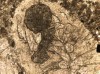
2) as an internal cement within the zooecia of bryozoan skeletal grains and
the lumens of crinoid fragments (
Figure
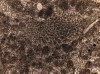
7e); 3) as cement filling fabric-selective pores, i.e., intraparticle
voids (
Figure
7f); and 4) as mimic replacement of bryozoan grains (
Figure
7g).
All of the characteristics of the peloids - their uniform crystal
size, restricted size range, consistent texture, monomineralogy, opaque nuclei,
and euhedral outer rims- suggest that they are in situ precipitates which
formed through cementation on or just below the sea floor (Tucker and Wright,
1990; Malone and others, 2001; Bosak and others, 2004. This peloidal fabric
characterizes most of the fine-grained rocks in the Trenton and Black River
carbonates that we examined.
The most compelling evidence for interpreting these peloidal
textures as marine cement is the fact that this fabric is ubiquitous in Trenton
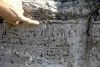
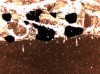
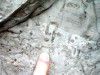
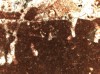
and Black River Group hardgrounds throughout the basin (Figure 8). Hardgrounds
are synsedimentarily lithified carbonate seafloors that become hardened in
situ by the precipitation of carbonate cement in the primary pore space (Wilson
and Palmer, 1992, p.3). They are sedimentary horizons in marine carbonates
that exhibit evidence of exposure on the sea floor as lithified rock. Detailed
discussions of hardgrounds in the Trenton and Black River rocks of the Appalachian
basin can be found in Brett and Brookfield (1984) and Laughrey and others
(2003). All of the fine-grained or finely crystalline hardground lithologies
that we examined petrographically have a peloidal fabric.
A note on classification: The Dunham (1962) classification
of the sample shown in Figure 7 as a wackestone based on hand sample
description or a mixed-fossil/peloidal grainstone based on thin
section description is wrong because the fine calcite crystal size and peloidal
fabric do not reflect the limestone's depositional texture. The Folk (1962)
classification sparse biopelmicrite provides a better name for
the rock, although one might argue for sparse biopelsparite instead
(see Scholle and Ulmer-Scholle, 2003, p.266 - 271). We prefer the former
Folk (1962) name because the peloidal nuclei volumetrically dominate the
rock and their micron-size calcite crystals can be properly called micrite
(see Scholle and Ulmer-Scholle, 2003, p. 266). An alternate name, from the
classification scheme of Wright (1992) is cementstone.
Other Calcite Cements
In addition to the peloidal calcite cements just discussed,
calcite cement also occurs as prismatic fibrous to bladed rinds, meniscus-type
cement, syntaxial overgrowths on allochems, poikilotopic calcite spar, and
void-filling spar. We interpret these various calcite cements as products
of both marine and burial diagenesis.
Prismatic fibrous to bladed rinds of calcite are common on all
allochems we observed in the Trenton and Black River limestones. These crystals
may grow directly on the allochems, or atop micrite envelopes. Good examples
are shown
Appendix
II (Prismatic fringe examples 1 - 3). These morphologies are typical of
modern high-Mg calcite and aragonite cements (Scholle and Ulmer-Scholle, 2003),
but probably precipitated as calcite in the Ordovician sea (Lowenstein and
others, 2001).
We observed unique
meniscus-type cement (Hillgartner
and others, 2001) in oolitic grainstones of the Black River Formation at Union
Furnace, Pennsylvania (
Appendix
I, nonskeletal grains, ooid example #5). Meniscus cements usually are
cited as evidence for meteoric diagenesis in the vadose zone (James and Choquette,
1984; Scholle and Ulmer-Scholle, 2003), but Hillgartner and others (2001)
demonstrated a marine diagenetic origin for microbially-induced meniscus cements
in carbonate sands of the Bahamas and Mesozoic platform carbonates of the
Swiss and French Jura Mountains. These authors cautioned that an interpretation
of early vadose diagenesis should not be based on meniscus cement alone. They
suggested the term
meniscus-type cement for these unique marine cements
that form in association with the calcification of microbial filaments and
the trapping of percolating micrite in subtidal settings. The
meniscus-type
cements in the Black River oolitic grainstones occur along with grapestone,
oolitic intraclasts, micritized grains, bladed calcite rinds, and hardgrounds
all suggesting sea floor lithification.
Syntaxial calcite overgrowths are common on echinoid fragments
in the Trenton and Black River rocks of the Appalachian basin (
Appendix
II, Syntaxial Overgrowths Examples #1 and #2). Such cements are reported
from meteoric, marine, and burial diagenetic environments (Scholle and Ulmer-Scholle,
2003), ands require careful geochemical and petrographic arguments in order
to be diagnostic (Tucker and Wright, 1990). We interpret the syntaxial overgrowths
in the Trenton and Black River Formations as products of marine and/or burial
diagenesis because of their association with other marine cements in the rocks
and the lack of any evidence for exposure to the meteoric environment (i.e.,
lack of grain dissolution and no evidence whatsoever of karst processes).
Poikilotopic spar is likewise common (
Appendix
II, Poikilotopic spar Examples 1#1 and #2) and we interpret it to be of
marine and/or burial diagenetic origin too.
Drusy mosaics of calcite spar fill most primary pore space in
the Trenton and Black River Formations in the Appalachian basin (
Appendix
II, Equant Calcite Spar Examples #1 and #2, Drusy Spar Examples #1 and
#2). The precipitation of this calcite spar followed chemical compaction of
the limestones (
Appendix
II, Compaction Examples #5 and #6) indicating that these are clearly burial
diagenetic environment cements (Wright and Tucker, 1990, p.352). Additional
observations supporting this conclusion include broken and collapsed micrite
envelopes within the spar and fractured grains cemented by the spar.
Neomorphism
A number of neomorphic fabrics occur in the Trenton and Black
River rocks of the Appalachian Basin (
Appendix
II). Microspar and pseudospar commonly replace micrite in muddy carbonate
rocks. Most of this is aggrading neomorphism (
Appendix
II, Neomorphism examples #1 - #3). Microspar and pseudospar also commonly
replace allochems (see Appendix I, Coral Example #2 and #3).
Replacement
Numerous noncarbonate minerals replace both limestone and dolomite
in the Trenton and Black River Formations. These include chert, chalcedony
and quartz, feldspar, iron sulfides and oxides, sphalerite, fluorite, phosphate,
sulfates, and chlorides. Some examples follow.
Chert and chalcedony replace both limestone and dolomite in
the Trenton and Black River rocks throughout the Appalachian basin.
Appendix
II (Silicification Examples 31 - #4) and Figure 9 show examples of this
replacement. Chalcedony that replaces hydrothermal dolomite is length-slow
(Figure 9), possibly implying that the replacement took place in a sulfate-rich
aqueous environment (Folk and Pittman, 1971; Scholle and Ulmer-Scholle, 2003).
Compaction (including pressure solution)
Compaction fabrics in the Trenton and Black River Formations
are widespread throughout the basin. They include mechanical compaction features
such as plastic deformation of soft grains and brittle fractures in grains,
and chemical compaction features such as cocavo-convex and sutured contacts
between grains, dissolution seams, and stylolites. Examples of these are provided
in
Appendix
II.
Dissolution
There is very little evidence for dissolution features in the
limestones of the Trenton and Black River Formations in the basin. This is
consistent with what is known of the Ordovician carbonate systems on a global
scale (Markello and others, 2005), and with recent work on the local scale
by Harris (2005) and Smith and others (2005). Limestone dissolution adequate
for creating commercial reservoirs is restricted to processes associated with
dolomitization adjacent to fractures. These are discussed below.
to top
DOLOMITE TEXTURES, DIAGENESIS, AND POROSITY
Several prolific petroleum reservoirs are hosted in dolostones
in the Black River Formation in south central New York and north central Pennsylvania.
Equally productive dolostone reservoirs in the Trenton Formation were developed
in northwestern Ohio in the late 1800's and early 1900's and produced that
state's only giant field (Wickstrom and others, 1992). Recent exploration
in Ohio has discovered Trenton and Black River dolostone reservoirs in the
north central and northeastern parts of the state. Similar dolostone reservoirs
in these rocks and their equivalents produce petroleum in Kentucky, Tennessee,
Michigan, Ontario and elsewhere. The petrographic and related petrophysical
characteristics of the dolomite reservoir rocks are of great interest to geologists
and engineers working in this play. It is clear that these petroleum reservoirs
developed in hydrothermal dolomites, that these hydrothermal dolomites formed
in the subsurface during the interaction of hot saline brines with the carbonate
country rock, and that the hydrothermal brines migrated into the rocks they
altered via faults, specifically basement-related faults with some strike-slip
component (Wickstrom and others, 1992; Smith and others, 2005). It also is
clear from petrographic studies that the hydrothermal fluid flux, which generated
the dolomite, both created and destroyed reservoir porosity in these essentially
tight rocks. The porosity and permeability distribution and evolution in the
Black River and Trenton dolostone reservoirs is a direct function of 1) fractures
and 2) variable reaction stoichiometry during limestone replacement and/or
dolomite recrystallization as hydrothermal brines moved through these rocks
via fault-related fractures.
Two basic dolomite textures exist in sedimentary rocks- planar
dolomite and nonplanar dolomite (Woody and others, 1996). Planar dolomite
crystals have straight boundaries, whereas nonplanar dolomite crystals have
curved, lobate, serrated, indistinct, or otherwise irregular boundaries, and
often have undulatory extinction (Sibley and Gregg, 1987, p. 970). Planar
dolomite forms in both near-surface and burial diagenetic environments. Near-surface
diagenetic environments extend to a few hundred meters of depth and are influenced
by local groundwater flow systems; burial environments extend from the near
surface to depths in excess of 3000 m and are influenced by intermediate to
regional groundwater flow systems (Machel, 1999). Nonplanar dolomite develops
at temperatures greater than 50°C in burial environments (Woody and others,
1996). Hydrothermal dolomites represent a special case of dolomitization in
the burial environment where the dolomite formed at a temperature at least
5 to 10°C higher than the temperature of the surrounding strata (Machel,
2004). Geochemical data presented by Smith and others (2005, and in the reports
of this research effort) demonstrate that the reservoir dolomites of the Black
River and Trenton play in the Appalachian basin satisfy this criterion. The
massive, mostly nonplanar hydrothermal dolomites of the Black River and Trenton
reservoirs discussed in this report formed locally around faults in burial
environments (Smith and others, 2005).
For this report we chose to use the dolomite textural classification
of Wright (2001). Wright's classification combines those of Sibley and Gregg
(1997) and Gregg and Sibley (1994) with the recognition of a transitional
texture between planar and nonplanar dolomite. The classification has two
principal categories: 1) crystal size distribution - unimodal or polymodal,
and 2) crystal boundary shape - planar or nonplanar. Planar crystal boundaries
are further subdivided as euhedral (planar-e) or subhedral (planar-s). Planar-c
dolomite is cement that lines or fills pores and planar-p dolomite is porphyrotopic.
Nonplanar dolomite occurs as anhedral dolomite mosaics (nonplanar-a), saddle
dolomite (nonplanar), and porphyrotopic crystals (nonplanar-p). Our complete
textural description includes recognizable grains, matrix, and cement. Allochems
and cements may be unreplaced, partially replaced, or completely replaced.
Replacement may be mimetic or non-mimetic. Figures A3-1 through A3-9 show
some of the various types of dolomite textures we observed in the Trenton
and Black River rocks of the Appalachian basin.
There are two distinct types of dolomite in the Trenton and
Black River rocks of the Appalachian basin- planar and nonplanar dolomites.
The first type of dolomite (TYPE I) consists of micron- to centimicron-size
(usually decimicron-size) planar dolomites. Most of this dolomite is matrix-selective
replacement dolomite, but some planar-p and planar-e dolomites locally replace
allochems too, and we observed a few examples of void filling planar-c dolomite
cement (Figure A3-5). These planar dolomites are pervasively developed in
thin beds of supratidal and intertidal carbonate facies (Figure A3-3B), and
also occur in all subtidal facies throughout the basin as common, but intermittent
lenses, laminae, and very thin beds (
Figure A3-2C). The former planar dolomite
probably formed in peritidal environments through reflux and/or mixing zone
dolomitization; the latter formed on a local scale in buried subtidal sediments
via compaction-driven fluid flow (see Machel, 2004, Figure 19). The planar
dolomite textures also occur as a limestone replacement adjacent to faults;
these crystals are probably hydrothermal (Smith and others, 2005; Harris,
2005), and clearly predate later nonplanar dolomite.
The second type of dolomite (TYPE II) consists of decimicron-
to millimeter-size (usually centimicron-size) transitional and nonplanar dolomites.
Planar-s to nonplanar (transitional) dolomite and nonplanar-a dolomite occur
as an obliterative replacement of limestone (matrix and allochems) and as
neomorphic recrystallization of planar dolomite. Nonplanar (saddle) dolomite
occurs as pore-lining and pore-filling cement. The transitional and nonplanar
dolomites occur only in association with localized, basement-related faulting
and fracturing, and are most likely hydrothermal in origin (see Wickstrom
and others, 1992, Harris, 2005, and Smith and others, 2005).
The iron content of both types of dolomite is highly variable
throughout the basin. Harris (2005) reports that fault-related, relatively
early planar dolomites in central Kentucky are nonferroan, with some iron
zoning evident in the crystals, and that later nonplanar (saddle) type dolomites
are iron-rich. Conversely, in northwestern Ohio, the so-called "cap dolomite"
(texturally a planar type dolomite) at the top of the Trenton Formation there
consists of ferroan decimicron-size planar dolomite (Keith, 1988,) while the
fracture-associated nonplanar dolomites may be ferroan (Budai and Wilson,
1986), slightly ferroan (Taylor and Sibly, 1986), or nonferroan (Haefner and
others, 1988). Other planar dolomites in Ohio (so-called "regional dolomite")
reportedly are nonferroan (Taylor and Sibley, 1986; Keith, 1988). Smith and
others (2005) report ferroan planar and nonplanar type dolomites in the subsurface
of central New York State. Using EDS in conjunction with SEM microscopy, we
measured iron concentrations from 2.17 to 4.26 wt. percent in nonplanar dolomites
from New York. In Ohio samples, we measured iron concentrations from 0 to
1.5 wt. percent in planar dolomites (nonferroan) and 0.28 to 10.92 wt. percent
in nonplanar dolomites. The highest iron concentrations occur in nonplanar
(saddle) dolomite cements that line and fill pores.
Rocks recovered from most of the Trenton and Black River dolostone
reservoirs in the Appalachian basin exhibit a complex combination of planar
and nonplanar crystal textures. It is clear that epigenetic dolomitization
and neomorphic dolomite recrystallization took place in response to exposure
of the rocks to hydrothermal mineralizing fluids, and the resultant textures
overprint both precedent limestone diagenetic fabrics and earlier diagenetic
dolomites textures.
Association with Base-Metal Sulfide Mineralization
The formation of dolomite reservoirs in the Black River and
Trenton Formations was a direct result of massive geochemical and textural
alteration of their precursor carbonate mineralogy and fabric by hydrothermal,
basinal saline brines (Davies, 2000; Gregg, 2004; Smith and others, 2005,
and data generated during this research). These alterations included 1) dolomitization
of limestone and neomorphic recrystallization of planar dolomites, 2) iterative
precipitation of pore-filling nonplanar (saddle) dolomite, calcite, quartz,
sulfates, halides, sulfides, and supergene metal oxides alternating with intervals
of 3) carbonate dissolution. Appendices 3 and 4 and 5 show examples of all
of these alterations. Geochemical evidence for the hydrothermal origin of
these alterations is given elsewhere in this research by Smith, and will be
presented in final form at the conclusion of this project.
This association of hydrothermal dolomitization and base-metal
sulfide mineralization adjacent to faults is directly responsible for reservoir
porosity and permeability in the Trenton and Black River carbonates of the
Appalachian basin. These carbonates were rendered remarkably tight by limestone
diagenesis, particularly marine diagenesis on and just below the sea floor,
and by neomorphism during early burial. Excellent commercial porosity and
permeability developed only where the hot basinal brines invaded the Trenton
or Black River limestones via fault-related fractures. Dolomitization did
more to reduce and destroy porosity, however, than it did to enhance it (Figure
10). Fractured limestones in these formations are productive in West Virginia
and Kentucky, but these fields do not have the same kind of reserves or sustained
production as those developed in dolomite in Ohio, New York, or Pennsylvania.
All of the dolomite fabrics observed in these rocks developed
before significant chemical compaction took place, an observation that constrains
the timing of fracturing and hydrothermal dolomitization. Porosity and Permeability
We use two fundamental porosity classifications in this report. The first
is that of Choquette and Pray (1970), which defines the basic type of porosity
present in a carbonate rock, and then provides an indication of the pore space's
genesis and abundance. In this texturally descriptive scheme, the voids are
fabric selective, not fabric selective, or some combination thereof. The carbonate
components, crystals, or other physical structures in the rock control fabric
selective pores - the voids do not cross the boundaries of these features.
Pores that are not fabric selective do cross the component boundaries and
are larger that the carbonate allochems or crystals that contain them. We
also use the carbonate pore size classification of Luo and Machel (1995),
which relates pore size to the fluid flow characteristics of the reservoir
rock.
There are distinctive pore textures in Trenton and Black River
dolograinstones, dolopackstones, dolowackestones, and dolomudstones. In the
productive dolograinstones and dolopackstones of northwestern Ohio, the porosity
development is partially related to depositional texture. This depositional
texture may or may not be readily recognizable to the unaided eye. The reservoir
rocks consist of planar-s to nonplanar-a and saddle dolomite. Macroporosity
is not fabric selective, and consists of small to medium vugs and fractures.
Mesoporosity is fabric selective, and consists of moldic and intercrystalline
voids. Microporosity is both intercrystalline and intracrystalline. Porosity
developed through a combination of fracturing, selective dissolution of allochems
(usually crinoids), and dissolution of both calcite and dolomite. Appendix
5 includes numerous examples of these pore textures.
Dolowackestones and dolomudstones are the most productive reservoirs
in the Trenton and Black River play in the Appalachian basin. The depositional
texture of these rocks is readily recognizable (see Appendix 5). These rocks
consist of planar-s to nonplanar-a dolomites and saddle dolomites. Macroporosity
is not fabric selective, and consists of 1) voids associated with zebra and
breccia fabrics, 2) small to large vugs, and 3) fractures. Mesoporosity is
fabric selective, consisting of intercrystalline and moldic voids. Microporosity
is both intercrystalline and intracrystalline. Porosity developed through
fracturing, associated brecciation, and dissolution of both calcite and dolomite.
Appendix 5 provides several examples of these pore textures. Petrophysical
Considerations The dominance of vuggy porosity in Trenton and Black River
reservoirs, and their association with intercrystalline and fracture voids,
yields a complex pore geometry. The predominance of planar-s to nonplanar
dolomite textures means that we can expect bimodal to intermediate Hg capillary
pressure curves with steep gradients in these rocks, reflecting poorly interconnected
pore networks with large pore to throat size ratios (Woody and others, 1996).
The best reservoirs occur where fractures provide interconnections between
large dissolution voids yielding collapse breccias and adjacent zebra fabrics.
Geologists and engineers should anticipate the fact that the Archie equation
is unreliable for geophysical log evaluation in these and use appropriate
alternate techniques (Asquith, 1985).
to top
REFERENCES
- Allan, J. R. and W. D. Wiggins (1993), Dolomite
reservoirs, geochemical techniques for evaluating origin and distribution,
AAPG Continuing Education Course Notes Series No. 36, 129 p.
- Asquith, G. B. (1985), Handbook
of log evaluation techniques for carbonate reservoirs, AAPG Methods
in Exploration Series No. 5, 47 p.
- Bathurst, R. G. C. (1975), Carbonate
sediments and their diagenesis, Amsterdam, Elsevier, 658 p.
- Bosak, T., V. Souaz-Egipsy, and D. K. Newman (2004),
A laboratory model of abiotic peloid formation,
Geobiology, V. 2, (3), p. 189 - 198.
- Brett, C. E. and M. E. Brookfield (1984), Morphology,
faunas, and genesis of Ordovician hardgrounds from southern Ontario, Canada,
Paleogeography, Paleoclimatology, and Paleoecology, V. 46, p. 233 - 290.
- Budai, J. M. and J. L. Wilson (1986), Depositional
patterns and diagenetic history of Trenton-Black River formations in Michigan
basin (abs.), AAPG Bulletin, V. 70, p. 1063.
- Cantrell, D. L. and R. M. Hagerty (1999), Microporosity
in Arab Formation carbonates, Saudi Arabia, GeoArabia, V. 4 (2),
Gulf PetroLink, Bahrain, p. 129 - 154.
- Chafetz, H. S. (1986), Marine peloids:
a product of bacterially induced precipitation of calcite, Journal
of Sedimentary Petrology, v. 56, p. 8121 - 817.
- Choquette, P. W. and L. C. Pray (1970), Geologic
nomenclature and classification of porosity in sedimentary carbonates,
AAPG Bulletin, 75, p. 207 - 250.
- Davies, G. R. (2000), Hydrothermal
dolomite reservoir facies: global and western Canada perspectives,
Course Notes, Second Edition, Graham Davies Geological Consultants LTD.,
Calgary, Alberta, 214 p.
- Dunham, R. J. (1962), Classification
of carbonate rocks according to their depositional texture, in W. E. Ham,
ed. Classification of carbonate rocks - a symposium, Tulsa OK, AAPG
Memoir I, p.108 - 121.
- Folk, R. L. (1962), Spectral subdivision
of limestone types, in W. E. Ham, ed. Classification of carbonate rocks
- a symposium, Tulsa OK, AAPG Memoir I, p. 62 - 84.
- Folk, R. L. and J. S. Pittman (1971), Length-slow
chalcedony: a new testament for vanished evaporites, Journal of Sedimentary
Petrology, 41, p. 1045 - 1058.
- Friedman, G. M. and J. E. Sanders (1978), Principals
of Sedimentology, New York, John Wiley and Sons, Inc., 792 p.
- Gregg, J. M. (2004), Basin fluid
flow, base-metal sulphide mineralization and the development of dolomite
petroleum reservoirs, in Braithwaite, C. J. R., G. Rizzi, and G.
Darke (eds.): The geometry and petrogenesis of dolomite
hydrocarbon reservoirs, Geological Society, London, Special Publications,
235, p. 157 - 175.
- Gregg, J. M. and D. F. Sibley (1984), Epigenetic
dolomitization and the origin of xenotopic dolomite texture, Journal
of Sedimentary Petrology, 54, p. 908 - 931.
- Haefner, R. J., J. J. Mancuso, J. P. Frizado, K. L.
Shelton, and J. M. Gregg (1988), Crystallization temperature
and stable isotope compositions of Mississippi Valley-Type carbonates and
sulfides of the Trenton Limestone, Wyandot County, Ohio, Economic
Geology, 83, p. 1061 - 1069.
- Harris, D. C. (workshop director) (2005), Central
Kentucky outcrop analogs for Trenton/Black River dolostone reservoirs, project
review and core workshop, June 1, 2005, Lexington, KY, Petroleum
Technology Transfer Council Focused Technology Workshop course notes.
- Hillgartner, H. C. Dupraz, and W. Hug (2001), Microbially
induced cementation of carbonate sands: are micritic meniscus cements good
indicators of vadose diagenesis? Sedimentology, 48, p. 117 - 131.
- Hunt, J. M. (1996), Petroleum geochemistry
and geology, New York, W. H. Freeman and Company, 743 p.
- James, N. P. and P. W. Choquette (1984), Diagenesis
9, Limestones - the meteoric diagenetic environment: Geoscience Canada,
11, p. 161 - 194.
- Keith, B. D. (1988), Reservoirs
resulting from facies-independent dolomitization: case histories from Trenton
and Black River carbonate rocks of the Great Lakes area, in Keith,
B. D. ed., The Trenton Group (Upper Ordovician Series)
of eastern North America, deposition, diagenesis, and petroleum,
AAPG Studies in Geology #29, p. 267 - 278.
- Laughrey, C. D., J. Kostelnik, D. P. Gold, A. G. Doden,
and J. A. Harper (2003), Trenton and Black River carbonates
in the Union Furnace area of Blair and Huntingdon Counties, Pennsylvania,
Field Trip Guidebook, AAPG-SPE Eastern Section Meeting, September 10, 2003,
80 p.
- Lighty, R. G. (1985), Preservation
of internal reef porosity and diagenetic sealing of submerged early Holocene
barrier reef, southeast Florida shelf, in N. Schneidermann and P.
M. Harris, eds, Carbonate cements, SEPM Special
Publication No. 36, p.123 - 151.
- Lowenstein, T. K., M. N. Timofeeff, S. T. Brennan,
L. A. Hardie, and R. V. Demicco (2001), Oscillations
in Phanerozoic seawater chemistry: evidence from fluid inclusions,
Science, 294, p. 1086 - 1088.
- Luo, P. and H. G. Machel (1995), Pore
size and pore throat types in a heterogeneous dolostone reservoir, Devonian
Grosmont Formation, western Canada sedimentary basin, AAPG Bulletin,
79, p. 1698 - 1720.
- Machel, H. G. (1999), Effects of
groundwater flow on mineral diagenesis, with emphasis on carbonate aquifers,
Hydrogeology Journal, 7, p. 94 - 107.
- Machel, H. G. (2004), Concepts
and models of dolomitization: a critical reappraisal, in Braithwaite,
C. J. R., G. Rizzi, and G. Darke (eds.): The geometry
and petrogenesis of dolomite hydrocarbon reservoirs, Geological Society,
London, Special Publications, 235, p. 7 - 235.
- Macintyre, I. G. (1985), Submarine
cements - the peloidal question, in N. Schneidermann and P. M. Harris,
eds., Carbonate cements, SEPM Special Publication No. 36, p.109 - 116.
- Malone, M. J., N. C. Slowey, and G. M. Henderson (2001),
Early diagenesis of shallow-water periplatform carbonate
sediments, leeward margin, Great Bahama Bank (Ocean Drilling Program Leg
166), Geological Society of America Bulletin, 33 (7), p. 881 - 894.
- Markello, J. R., R. B. Koepnick, and L. E. Waite (2005),
The carbonate analogues through time (CATT) hypothesis
- a systematic and predictive look at Phanerozoic carbonate reservoirs,
2005 AAPG Annual Convention, Technical Program and Abstracts, http://aapg.confex.com/aapg/cal2005/techprogram/meeting_cal2005.htm>.
- McKee, E. D. and R. C. Gutschick (1969), History
of Redwall Limestone of northern Arizona, Boulder, CO., Geological
Society of America Memoir 114, 726p.
- Pettijohn, F. J., P. E. Potter, and R. Siever (1987),
Sand and sandstone, New York, Springer-Verlag,
553 p.
- Pope, M. and J. B. Steffen (2003), Widespread,
prolonged late Middle to Late Ordovician upwelling in North America: a proxy
record of glaciation?, Geology, 31, p. 63 - 66.
- Scholle, P. A. and D. S. Ulmer-Scholle (2003), A
color guide to the petrography of carbonate rocks: grains, textures, porosity,
diagenesis, Tulsa, OK, American Association of Petroleum Geologists
Memoir 77, 474 p.
- Sibley, D. F. and J. M. Gregg (1987), Classification
of dolomite rock textures, Journal of Sedimentary Petrology, 57,
p. 967 - 975.
- Smith, L., R. Nyahay, and B. Slater (2005), Hydrothermal
dolomite core workshop and field trip, June 7, 2005, Albany, NY,
U. S. Department of Energy, Petroleum Technology and Transfer Council, Appalachian
Region and NYSERDA, short course notes.
- Taylor, T. R. and D. F. Sibley (1986), Petrographic
and geochemical characteristics of dolomite types and the origin of ferroan
dolomite in the Trenton Formation, Ordovician, Michigan basin, USA,
Sedimentology, 33, p. 61 - 86.
- Thompson, A. M. (1999), Chapter 5. Ordovician, p.74
to 89, in Schultz, C. H., ed., The Geology of Pennsylvania,
Part II, Stratigraphy. Pennsylvania Geological Survey, 4th Series,
Special Publication 1, 888 p.
- Tucker, M. E. and V. P. Wright (1990), Carbonate
sedimentology, Oxford, UK, Blackwell Science Ltd., 482 p.
- Wickstrom, L. H., J. D. Gray, and R. D. Stieglitz (1992),
Stratigraphy, structure, and production history of the
Trenton Limestone (Ordovician) and adjacent strata in northwestern Ohio,
Ohio Division of Geological Survey, Report of Investigations No. 143, 78
p.
- Wilson, M. A. and T. J. Palmer (1992), Hardgrounds
and hardground faunas, University of Wales, Aberystwyth Institute
of Earth Studies Publications No. 9, 131 p.
- Woody, R. E., J. M. Gregg, and L. F. Koedertz (1996),
Effect of texture on petrophysical properties of dolomite:
evidence from the Cambrian-Ordovician of southeastern Missouri, AAPG
Bulletin, 80, p.119 - 132.
- Wright, V. P. (1992), A revised
classification of limestones, Sedimentary Geology, 76, p. 177 - 185.
- Wright, W. R. (2001), Dolomitization,
fluid flow, and mineralization of the Lower Carboniferous rocks of the Irish
Midlands and Dublin basin, PhD thesis, University College Dublin,
Belfield, Ireland.
to top
FIGURES AND APPENDICIES
Figure Captions
(Click on thumbnail image for an expanded view.)
| Figure 1. Carbonate matrix in the Trenton
and Black River Formations. |
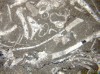 |
Figure 1A.
Skeletal wackestone (Dunham, 1962) or a
packed biomicrite (Folk, 1962) from the Black River Formation, Union Furnace,
Huntingdon County, PA. The matrix consists of microcrystalline calcite,
or micrite, which is presumed to have formed through the breakdown of
coarser carbonate grains (Scholle and Ulmer-Scholle, 2003). Note that
most of the skeletal material has undergone neomorphic recrystallization
or solution followed by cavity filling with calcite cement. |
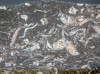 |
Figure 1B.
Dark organic-rich matrix in a skeletal
wackestone or packed biomicrite from the Trenton Formation at Union Furnace,
PA. The carbonate matrix material consists of microspar (crystals 5 -
20 m in size) presumably recrystallized from micrite. The dark, clotted
organic matrix matter is kerogen. |
| Figure 2. Trenton Formation at Union Furnace,
PA. |
|
Figure 2.
Limestone tempesites or turbidites interbedded
with siliciclastic shales in the Trenton Formation at Union Furnace, PA. |
| Figure 3. Very fine-grained
quartz arenite from a very thin sandstone bed in the Black River Formation,
Union Furnace, Huntington County, PA. |
|
Figure 3A.
Low magnification view (crossed polars)
showing well sorted subrounded grains of quartz and minor feldspar cemented
by calcite microspar and some anhydrite. |
|
Figure 3B.
Higher magnification view of sandstone shown
in
Figure 3A
showing calcite and anhydrite cements and feldspar grains. |
| Figure 4. K-bentonites in the Trenton
and Black River Formations. |

|
Figure 4A.
Deicke k-bentonite exposed at Union Furnace,
PA. |
|
Figure 4B.
Millbrig k-bentonite recovered in core
of the Trenton Formation cut 500 ft. west of the Union Furnace outcrop.
|
|
Figure 4C.
Millbrig k-bentonite at 1550 ft. in the
Chevron 1A Prudential core, Marion County, OH. |
| Figure 5. Completely micritized ooids
in the Black River Formation. |
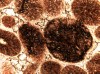
|
Figure 5.
Completely micritized ooids in the Black
River Formation. |
|
Figure 6. Micrite envelope on echinoid grain and peloidal cement. |

|
Figure 6A.
The large echinoid fragment in the left-center
of the photomicrograph exhibits a bored rim and well-developed micrite
envelope. |
|
Figure 6B.
The same photomicrograph in cross-polarized
light reveals that the micrite envelope actually consists of calcite cement
with a peloidal texture. Note that this peloidal cement grades into coarser
peloidal cement that fills some of the pore spaces adjacent to the grain
in the southeast and northwest quadrants. Identical peloidal cement fills
the zooecia of bryozoan grains. |
|
Figure 6C.
High magnification view of the peloidal
cement that fills both the bored edge of the echinoid grain and the void
space immediately below it. The rest of the void space is filled with
calcite spar. Montgomery #4 well, Mercer County, PA. Trenton Formation,
8495 ft. |
| Figure 7. Peloidal cement fabric in the Black River Formation. |

|
Figure 7A.
Core sample of apparent burrowed and bioturbated wackestone (Dunham, 1962)
or sparse biomicrite (Folk, 1962). Gray #1 well, Steuben County, NY, 7823
ft.).
|
|
Figure 7B.
Thin section photomicrograph of the same sample. Peloids comprise
75% of the limestone. Based on this information we can modify the Folk (1962)
name for this rock to a sparse biopelmicrite. Using the Dunham (1962) classification
we could rename the rock a peloidal/mixed-fossil grainstone, which is erroneous
because the peloids are not grains but are cement.
|
|
Figures 7C and 7D.
Progressively higher magnification
views of the same sample. Note that the peloids consist of 1) a dark nucleus
of micron-size calcite (opaque clots) surrounded by 2) rims of euhedral
microspar. |
|
Figure 7E.
Another thin section view of peloidal cement
in the same sample. Here peloidal cement fills the zooecia of a bryozoan
fragment as well as lithifies the matrix. |
|
Figure 7F.
Peloidal cement fills a void formed earlier
through dissolution of part of a bryozoan fragment.
|
|
Figure 7G.
Peloidal cement that
once filled all of the zooecia of a bryozoan grain now mimics the original
fossil structure.
|
| Figure 8. Hardgrounds and peloidal cements. |
|
Figure 8A.
Stacked, amalgamated hardground in the Trenton
Formation exposed southeast of Lexington in central Kentucky. The finger
points to the surface of a smooth and rolling hardground, but those beneath
exhibit hummocky, undercut, pebbly, and reworked morphologies (see Brett
and Brookfield, 1984, Wilson and Palmer, 1992, and Laughrey and others,
2003). |

|
Figure 8B.
Plan view of bryozoans encrusting the top
of a hardground, Trenton Formation, central Kentucky. |
|
Figure 8C.
Thin section photomicrograph of the hardground
surface that the geologist's finger points to in A. Note the peloidal
cement texture of the limestone. Also note the authigenic pyrite at and
just above the hardground surface. |
|
Figure 8D.
A planar and undercut hardground in the
Black River Formation exposed at Union Furnace, Pennsylvania. |
|
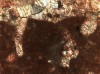
Figures 8E and 8F.
Thin section photomicrographs of
the hardground shown in D. The clotted fabric characteristic of peloidal
cements is evident in both photomicrographs. |
|
Figure 9. High magnification view of chalcedony replacing nonplanar
dolomite that mimically replaces a crinoid grain (see Figure A3-8 in Appendix III for additional views of this sample).
|
|---|
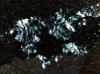 |
Figure 9A.
View under crossed polars showing the typical
radiating habit of chalcedony. |
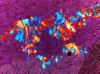
|
Figure 9B.
Same view, but with the gypsum plate inserted
into the microscope. The birefringence colors in the northeast and southwest
quadrants increased, and the birefringence colors in the northwest and
southeast quadrants decreased, indicating that the chalcedony is length-slow.
|
| Figure 10. Macropores and mesopores in the
Black River Formation |
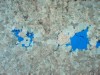 . . |
Figure 10.
Macropores and mesopores in the Black River Formation, Whiteman #1
well, Chemung County, NY, 9529 ft. Porosity consists of isolated small vugs
(not fabric selective), minor intercrystalline pores (fabric selective), and
fractures (not fabric selective). The rock consists of nonplanar-a dolomite,
and nonplanar (saddle) dolomite cement partially fills the vugs. The vugs
formed through dissolution of both calcite and dolomite. Note that dolomitization
mostly obliterated porosity in this rock.
|
to top
Appendix 3 Figure Captions.
Dolomite textures in the Trenton and Black River carbonate
rocks of the Appalachian basin.
(Click on thumbnail image for an expanded view.)
-
Figure A3-1. Type I planar-p dolomite.
-
All of the illustrated dolomites are matrix-selective and occur in subtidal
carbonate facies. These dolomites are not associated with fractures, faults,
or rock alteration by hydrothermal basinal brine. They probably formed
through burial dolomitization at a local scale via compaction-driven fluid
flow.
|
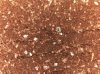
A. Planar-p dolomite replacing bioturbated, fossiliferous
pelmicrite. The dolomite crystals are polymodal, ranging in size from
40 to 200 m in diameter. The crystals have planar boundaries and are
porphyrotopic, floating in the limestone matrix they replaced. Most
dolomite crystals are cloudy due to inclusions, and some indistinct
zoning is evident in most crystals. The matrix is peloidal micrite
that we interpret as marine cement. Note the incipient solution seams,
outlined by micron-size pyrite crystals, which impart a somewhat lenticular
habit to the limestone. Some of the planar-p dolomite is partially
dissolved along these seams indicating the dolomite formed before
chemical compaction. Black River Formation, Power Oil Company #9634
well (Sandhill well), Wood County, WV, 9906 ft. |
|
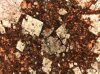
B. Finely to medium crystalline, polymodal, planar-p
dolomite replacing decimicron-size neomorphic calcite crystals. The dolomite
crystals are cloudy due to abundant inclusions, and predate fractures
in the rock. . Black River Formation, Power Oil Company #9634 well (Sandhill
well), Wood County, WV, 10,162 ft.
|
|
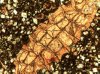
C. Polymodal, planar-p dolomite replacing matrix in a
sparse biopelmicrite in the Black River Formation. Outcrop sample from
Union Furnace, Huntingdon County, PA. |
- Figure A3-2. Type I planar-p and planar-e dolomite.
-
All of the illustrated dolomites are matrix-selective and
occur in subtidal carbonate facies. These dolomites are not associated
with fractures, faults, or rock alteration by hydrothermal basinal brine.
They probably formed through burial dolomitization at a local scale via
compaction-driven fluid flow.

|
A. Polymodal planar-e dolomite replacing
bioturbated, fossiliferous pelmicrite adjacent to stylolites. The
dolomite crystals are 2 to 100 m in diameter. Note the abundant inclusions
in the dolomite crystals. This planar-e dolomite resembles the planar-p
textures shown in the last three photomicrographs above, but the euhedral
dolomite now forms a mosaic that almost entirely replaces limestone
matrix. Note, however, the planar-p dolomite replacing limestone away
from the solution seam. Chemical compaction might have concentrated
the planar dolomite crystals along the solution seams. Black River
Formation, Power Oil Company #9634 well (Sandhill well), Wood County,
WV, 10,162 ft. |
|
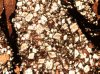
B. Higher magnification view of the
planar-e dolomite in Figure A3-2 A. Note that some of the dolomite
floats within the insoluble material of the seam, and is partially
dissolved along it too. Dolomitization predates chemical compaction.
|
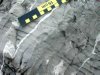
|
C. Laminae of brown planar-e dolomite
interbedded with thicker beds of skeletal limestone (wackestone and
packstone) in the Black River Formation exposed at the Union Furnace
outcrop in central PA. |
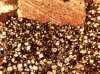
|
D. Thin section photomicrograph of
matrix-selective, polymodal planar-e dolomite replacing micrite in
one of the brown laminae shown previously in Figure A3-2C above. |
- Figure A3-3. Type I planar-e and planar-s dolomites.
-
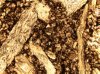
|
A. Thin section photomicrograph of decimicron-
to centimicron-size polymodal, planar-e to planar-s dolomite replacing
peloidal calcite cement in a grainstone. Trenton Formation, Melben
Oil Company Emma McKnight #1 well, Mercer County, PA, 6845.2 ft. This
dolomite is matrix-selective and occurs in a subtidal carbonate ramp
facies. This dolomite is not associated with fractures, faults, or
rock alteration by hydrothermal basinal brine. |
|
|
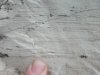
B. Micron- and decimicron-size polymodal
planar-e to planar-s dolomite in laminated peritidal carbonates. 1
and 2 are stromatolites exposed in the basal Black
River Formation at Union Furnace in Huntingdon County, PA in which
the dolomite replaced the original limestone. 3 and
4 show respective core and backscattered electron
SEM photographs of probable peritidal stromatolites in the Ohio #2854
well, Delaware County, Ohio (Trenton Formation, 2901 ft.). These planar
dolomites probably formed through reflux and/or mixing zone dolomitization.
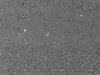
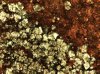
 1. 1.
 2. 2.
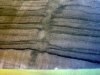 3. 3.
 4. 4.
|
|
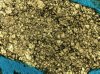
C. A hydrothermal dolomitization
front in the Black River Formation. Polymodal decimicron-size planar-e
dolomite partially replaces pelmicrite. Intercrystalline porosity
in the dolomite is filled by bitumen. This planar dolomite fabric
occurs in a zone near the top of a faulted and fractured subsurface
interval altered by hydrothermal dolomitization. The dolomite formed
through rock alteration by saline basinal brines (the dolomite 18O
= -9 permil, Smith, 2005, personal communication). Black River Formation,
Dominion Exploration and Production Company Bayles #1 well, Bradford
County, PA, 12,425 ft. |
|
D. Polymodal decimicron- and centimicron-size
planar-e to planar-s dolomite completely replacing pelmicrite. The
apparent intercrystalline porosity is filled with bitumen. This planar
fabric is associated with fracturing, faulting, and hydrothermal dolomitization.
Black River Formation, Dominion Exploration and Production Company
Bayles #1 well, Bradford County, PA, 12,425 ft. |
|
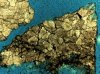
E. Hydrothermal decimicron- to centimicron-size
polymodal planar-s dolomite. Bitumen fills intercrystalline void space.
Also note the cutting composed of centimicron-size planar-s dolomite
in the upper left corner of the photograph. Black River Formation,
Dominion Exploration and Production Company Bayles #1 well, Bradford
County, PA, 12,425 ft. |
- Figure A3-4. Type I planar-c dolomite.
-
|
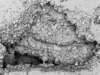
A. SEM photomicrograph of polymodal
(60 m to 300 m crystals) planar-c dolomite lining and partially filling
a small vug in the Trenton Limestone. Prudential 1A well, Marion County,
OH, 2013.5 ft. |
|
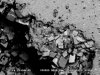
B. Higher magnification view of planar-c
dolomite shown in Figure A3-4A. This dolomite is in the upper right
corner of the vug. The cross on the crystal just right of the center
of the SEM photo shows the spot of the EDS analysis presented next
in Figure A3-4C. |
|
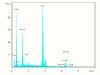
C. EDS spectra of the planar-c dolomite
shown in Figure A3-4B. The dolomite is not stoichiometric, having
an excess of Ca (Ca = 17.77%, Mg = 11.50 %), and it is ferroan (Fe
= 3.53 wt.%), indicating formation from saline basinal fluid (see
Allan and Wiggins, 1993). |
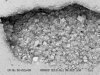 |
D. SEM photomicrograph of polymodal
decimicron- to centimicron-size planar-c dolomite lining a medium
vug in the Trenton Formation. The Fe concentration of this dolomite
is 8.98 wt.%, indicating saline basinal brine as the dolomitizing
fluid. Prudential 1A well, Marion County, OH, 1855 ft. |
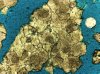
- Figure A3-5. Type II planar-s to nonplanar (transitional) dolomites.
-
|
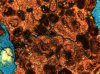
A. Planar-s to nonplanar (transitional) dolomite
replacing a peloidal or oolitic limestone. Compare the ghosts of the
peloids or ooids in this dolomite with the peloids (micritized ooids
and grains) in the limestone cutting from the same sample shown in
Figure A3-5B. Black River Formation, Dominion Exploration and Production
Company Bayles #1 well, Bradford County, PA, 12,425 ft. |
|
B. Peloidal limestone (pelsparite)
cutting from 12,425 ft. in the Bayles #1 well, Bradford County, PA.
The peloids, possibly micritized ooids, are cemented by calcite spar.
Compare with the dolomite in Figure A3-5A. |

|
C. Polymodal decimicron- to centimicron-size
planar-s to nonplanar-a (transitional) dolomite in the Black River
Formation, CNR Gray #1 well, Steuben County, NY, 7793 ft. |
|
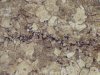
D. Polymodal decimicron- to centimicron-size
planar-s to nonplanar-a (transitional) dolomite in the Black River
Formation, CNR Gray #1 well, Steuben County, NY, 7793 ft. |
- Figure A3-6. Type II nonplanar-a dolomite textures.
-
All of the illustrated dolostones show fabric obliteration,
and are fault and fracture-related, hydrothermal, nonplanar dolomites.

|
A. Unimodal, medium crystalline nonplanar-a dolomite
(Black River Formation, Columbia Natural Resources Gray 24468 well,
Steuben County, NY, 7796 ft.). |
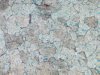 |
B. Higher magnification view of nonplanar-a
dolomite shown in Figure A3-6A. Note the tightly interlocked crystal
fabric and consequent lack of intercrystalline pore space. |
|
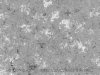
C. Backscattered SEM photomicrograph
of nonplanar-a dolomite texture. This sample is from the same well
core as those shown in Figure A3-6A and B, but is from a slightly
deeper interval at 7799.9 ft. The predominant medium gray is nonplanar-a
dolomite, which is not stoichiometric (Ca = 23.54 wt.%, Mg = 11.87
wt.%) and is ferroan (Fe = 2.17 wt.%). The white material is a chloride
(Cl = 20.35 wt.%) with notable sodium and potassium (Na = 7.10 wt.%,
K = 6.30 wt.%). The material does not appear in thin sections, probably
due to high solubility in water and loss during preparation of the
slide. It does appear as a dark, reddish, compact and granular mass
in the hand samples of the core. The material might be an admixture
of halite and sylvite, or a precipitate in the core that formed through
evaporation of a residual K-Na-Cl brine. |
|
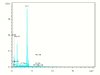
D. EDS spectra of the nonplanar-a
dolomite in Figure A3-6C. |
- Figure A3-7. Nonplanar (saddle) dolomite textures.
-
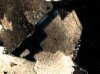
|
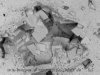
A. Nonplanar (saddle) dolomite cement partially
filling a small vug in the Trenton Formation (OH 3479, Anderson well,
Hancock Co., OH, 1337.8 ft.). Note the diagnostic spearhead crystal
shape, mottled salt and pepper appearance (due to inclusions), and
sweeping extinction under crossed polars. |
 |
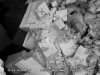
B. Backscattered SEM photomicrograph
of nonplanar (saddle) dolomite cement filling a small vug in the Trenton
Formation. This is the same sample shown in Figure A3-7A. The saddle
dolomite crystals exhibit the same spearhead shape observed in thin
section, and curved crystal faces are easier to see in this three
dimensional view. |
 |
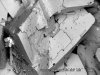
C. High magnification SEM view of
nonplanar (saddle) dolomite filling a small vug in the same Ohio sample
shown in Figure A3-7A and B. The cross on the crystal in the upper
center of the photograph is the spot of the EDS analysis shown in
Figure A3-7D. The saddle dolomite is not stoichiometric, with calcium
excess (Ca = 17.05 wt.%, Mg = 12.68 wt.%), and it is nonferroan (Fe
= 1.01 wt.%). |
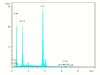 |
D. EDS spectra of nonplanar (saddle)
dolomite shown in Figure A3-7C. |
 |
E. Pore-filling nonplanar (saddle)
dolomite with oil staining in the Trenton Limestone. Note the curved
crystal faces. (OH 2549 core, Wood Co., OH, 1168.25 ft.). |
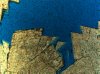 |
F. Nonplanar (saddle) dolomite lining
a large vug in the Black River Formation. (Whiteman #1 well, Steuben
Co., NY, 9531 ft.). |
 |
G. Backscattered SEM view of the
same sample shown in Figure A3-7F. Nonplanar (saddle) dolomite cement
lines a large vug. Note the bitumen coatings on some of the dolomite.
|
 |
H. Nonplanar (saddle) dolomite cement
completely fills a small vug in the same sample shown in Figures A3-7F
and G. |
- Figure A3-8. Limestone replacement textures.
-
Mimetic and non-mimetic replacement of original crinoid
bioclasts (originally composed of high-magnesium calcite) by planar-s
to nonplanar-a dolomite. All examples from the Trenton Formation, OH 3479,
Anderson well, Hancock Co., OH, 1337.8 ft.
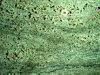
|
A. Core sample of vuggy crinoid/bryozoan dolograinstone
with mimetically replaced crinoid visible near the top center of the
photograph. A fabric selective intraparticle pore occurs in the crinoid's
central lumen. Vague circular rinds and halos around some mesopores
suggest they are non-mimetically replaced allochems. |
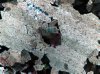 |
B. Thin section photomicrograph of
a mimetically replaced crinoid in the same sample shown in (1). Planar-s
to nonplanar-a dolomite replaced the original crinoid grain. Note
chert replacing the dolomitized crinoid in the upper left corner of
the fossil. |
- Figure A3-9. Hybrid dolomite fabrics.
-
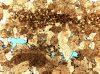
|
A. A small pocket of polymodal, decimicron-sized
planar-s dolomite surrounded by coarser (centimicron- to millimeter-sized)
planar and nonplanar dolomite. Centimicron-sized planar-s to nonplanar-a
dolomite surrounds the finer crystalline planar-s dolomite. Centimicron-sized
planar-e and centimicron- to millimeter-sized saddle dolomite both
partially fill large mesopores and medium vugs. Nonplanar (saddle)
dolomite also mimically replaces a large echinoderm fragment (lower
left) in this former skeletal grainstone. Trenton Formation, Strayer
#1 well, (OH 3478 core), Allen County, OH, 1211.25 ft. |
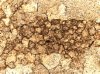 |
B. Higher magnification view of the
pocket of decimicron-sized planar-s dolomite shown in Figure A3-9A.
|
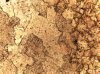 |
C. Contact between decimicron-sized
planar-s dolomite (right) and centimicron-sized nonplanar (saddle)
dolomite (left). Trenton Formation, Strayer #1 well, (OH 3478 core),
Allen County, OH, 1211.25 ft. |
 |
D. Same thin section photomicrograph
as Figure A3-9C, but with white index card inserted beneath the thin
section. Note the ghosts of the decimicron-sized planar-s dolomite
(identical to the same dolomite texture on the right) within the saddle
dolomite. This suggests that the saddle dolomite is a neomorphic recrystallization
product of the earlier diagenetic planar-s dolomite. |
to top
Appendix 4 Figure Captions.
Base metal sulfide mineralization.
- Figure A4-1.
-
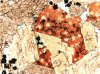
|
Late-stage calcite replacing nonplanar (saddle) dolomite.
Note the abundant pyrite associated with the calcite and dolomite. OH3267
core, Strayer #1 well, Allen County, OH, 1230.3 ft.
|
- Figure A4-2.
-
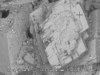
|
A. Calcite replacing nonplanar (saddle)
dolomite. Although the large, almost white crystal on the right side
of the SEM photo exhibits the characteristic morphology of saddle
dolomite, it's lighter color in the backscattered electron mode means
that it's composition is different than the adjacent saddle dolomites
in the picture. The EDS spectrum shown in B shows calcium excess in
the crystal. Trenton Formation, OH 3479, Anderson well, Hancock Co.,
OH, 1337.8 ft. |
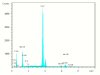
|
B. EDS spectra of the crystal shown
in A. |
- Figure A4-3.
-

|
Authigenic quartz replacing anhydrite in the Trenton Formation,
northwest Ohio.
|
- Figure A4-4.
-

|
Anhydrite and quartz replace nonplanar (saddle) dolomite
and fill a large vug in the Trenton Formation in the subsurface of northwestern
Ohio.
|
- Figure A4-5.
-
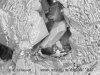
|
Authigenic quartz partially filling a small vug in the
Black River Formation, Gray #1 well, Steuben County, NY, 7803 ft.
|
- Figure A4-6.
-
Supergene mineralization in the Black River Formation in
the subsurface of south-central NY. Gray #1 well, 7799.9 ft., Steuben
County.
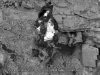
|
A. Bitumen coats a crystal of delafossite,
a copper-iron oxide that commonly occurs as a secondary mineral near
the base of the oxidized zone of copper deposits. Black crystals of
delafossite fill many small vugs in the Grey well core (it appears
white in this backscattered electron photomicrograph due to the high
atomic number of the copper and iron). |
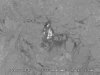
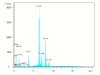
|
B. and C. show
the location of EDS analysis in this sample and the EDS spectra for
the white mineral. |
- Figure A4-7.
-
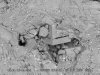
|
Nonplanar (saddle dolomite fills this small vug in the
Black River Formation (Gray #1 well, Steuben County, NY, 7803 ft.). White
specks throughout the SEM photo are anhydrite.
|
- Figure A4-8.
-
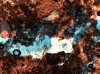
|
Opal partially fills a small vug in peloidal limestone
in the Black River Formation in the subsurface of north central Pennsylvania.
This sample is from a zone about 70 ft. above an extensively dolomitized
section in the well. Identification of the white mineral as opal is based
on its isotropic behavior under crossed polars and its index of refraction
less than epoxy. Bayles #1 well, Bradford County, Pa, 12,300 ft.
|
- Figure A4-9.
-
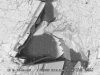
|
Bitumen filling intercrystalline pore space in dolostone, Grey #1 well, Steuben County, NY, 7803 ft.
|
- Figure A4-10.
-
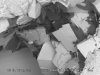
|
Bitumen filling intercrystalline pore space in dolostone, Whiteman #1 well, Chemung County, NY, 9531 ft.
|
to top
Appendix 5 Figure Captions.
Dolomite porosity in the Trenton and Black River Formations.
- Figure A5-1. Macroporosity in dolograinstone from northwestern
Ohio.
-

|
A. Small and medium vugs in dolostone
from the Trenton Formation. The rock's depositional texture is not
recognizable, but its origin as a crinoidal grainstone can be inferred
from adjacent core. OH3267 well core, Auglaize County, 1167.6 ft.
|

|
B. Small and medium vugs in crinoidal
grainstone from the Trenton Formation. Much of this sample's original
depositional texture was obliterated by dolomitization, but mimic
relics of some crinoids can be discerned. Voids in the crinoid lumen
(most likely moldic after calcite dissolution) provided the starting
porosity for subsequent enlargement into vugs. OH 3479, Anderson well,
Hancock Co., OH, 1337.8 ft. |
- Figure A5-2.
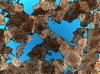
|
Thin section photomicrograph of the same crinoidal dolograinstone
shown in Figure A5-1B. Several types of pores are present in the rock
- small to medium vugs, molds, intercrystalline pores, and intracrystalline
voids. Several dolomite textures are evident, including nonplanar saddle
dolomite cement, planar-s to nonplanar-a dolomite, and planar-c dolomite.
|
- Figure A5-3.
-
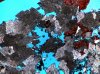
|
Thin section photomicrograph of the same crinoidal dolograinstone
shown in Figure A5-1B. Porosity developed through dissolution of dolomite
and late-stage calcite cement.
|
- Figure A5-4.
-
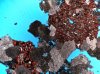
|
Thin section photomicrograph of the same crinoidal dolograinstone
shown in Figure A5-1B. Calcite is stained red, and some of the nonplanar
(saddle) dolomite cement appears pink due to partial replacement by calcite.
The vugs formed mostly through the dissolution of calcite, but dolomite
dissolution also contributed to the development of void space.
|
- Figure A5-5.
-
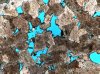
|
A. Thin section photomicrograph of
the same crinoidal dolograinstone shown in Figure A5-1B. Vugs and
molds formed by dissolution of calcite and dolomite. The area outlined
by the yellow box is shown in Figure A5-5B. |

|
B. Residue of calcite remaining after
dissolution created a small vug. |
- Figure A5-6.
-
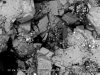
|
Backscattered SEM image of vuggy pore space in the same
crinoidal dolograinstone shown in Figure A5-1B. Planar-s to nonplanar-a
dolomite and nonplanar (saddle) dolomite surround the void, which also
contains pyrite left after calcite dissolution created the pore.
|
- Figure A5-7.
-
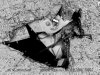
|
SEM image of a small triangular intercrystalline pore space
in the same crinoidal dolograinstone shown in Figure A5-1B.
|
- Figure A5-8.
-
|
SEM image of intercrystalline microporosity lining a small
vug space in the same crinoidal dolograinstone shown in Figure A5-1B.
|
- Figure A5-9.
-

|
Core sample of Black River dolomudstone with recognizable
depositional fabric. The matrix is quite tight, but fracturing, brecciation,
and dissolution created good reservoir porosity. Prudential #1A well (OH3372),
Marion County, OH, 1840 ft.
|
- Figure A5-10.
-

|
Core sample of Black River dolomudstone with recognizable
subtidal depositional texture. The matrix is tight, but both vuggy and
fracture porosity are evident. Nonplanar (saddle) dolomite and late-stage
calcite reduce the porosity in these secondary voids. Gray # 1 well, Steuben
County, NY, 7800 ft.
|
- Figures A5-11 and A5-12.
-
|
Thin section photomicrographs of the dolomudstone shown
in Figure A5-10. |
- Figure A5-13.
-
|
Backscattered SEM image of the dolomudstone shown
in Figure A5-10. Vuggy porosity developed through dissolution of nonplanar-s
to nonplanar-a dolomite groundmass, but nonplanar (saddle) dolomite
later reduced this secondary mesoporosity. |
- Figure A5-14 and A5-15.
-
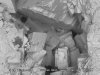
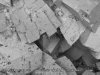
|
SEM views of nonplanar (saddle) dolomite reducing vuggy
pore space dolomudstone shown in Figure A5-10.. Bitumen stains the
crystals in both photomicrographs. |
- Figure A5-16.
-

|
Good mesoporosity and macroporosity development in bioturbated
dolomudstone, Whiteman #1 well, Chemung County, NY, 9529.3 ft. The matrix
is tight, but molds and small to medium vugs formed through dissolution.
Nonplanar (saddle) dolomite partially fills the vugs and molds.
|
- Figure A5-17.
-
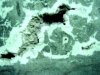
|
Close up view of nonplanar (saddle) dolomite partially
filling a medium vug in the same sample shown in Figure A5-16.
|
- Figure A5-18.
-

|
Thin section photomicrograph of the nonplanar (saddle)
dolomite partially filling vugs in the same sample shown in Figure A5-16.
|
- Figures A5-19 and A5-20.
-
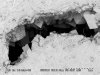
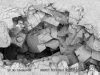
|
SEM photographs of nonplanar (saddle) dolomite partially
filling vugs in the same sample shown in Figure A5-16.
|
- Figure A5-21.
-

|
Zebra and breccia fabric in dolomudstone in pay zone of
the Whiteman #1well, Chemung County, NY, 9531 ft.
|
- Figure A5-22.
-
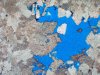
|
Thin section photomicrograph of medium vug in the same
core sample shown in Figure A5-21. Nonplanar (saddle) dolomite cement
partially fills the void space.
|
- Figures A5-23 and A5-24.
-
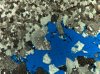

|
Thin section photomicrographs of macroporosity in the same
core sample shown in Figures A5-21 and A5-22. Note the partially dissolved
late-stage calcite crystals (red), and their residue along corroded dolomite
crystal boundaries and in intercrystalline void space.
|
- Figure A5-25.
-

|
This medium vug is in the same core sample shown in Figure
A5-21. The bitumen residue in the vug once lined nonplanar (saddle) dolomite
crystals (see Figure A5-26). It is not clear if the crystals were plucked
during thin section preparation or actually dissolved to create the void
space. Corroded remnants of the dolomite within the void suggest the latter
might be true.
|
- Figure A5-26.
-
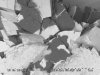
|
Backscattered SEM photograph of bitumen coating nonplanar
(saddle) dolomite that partially fills a medium vug in the Black River
Formation (Whiteman #1 well, Chemung County, NY, 9531 ft.).
|
to top
 "Figure 1A.")
 "FIGURE 1B.")
 "FIGURE 2.")
 "Figure 3A.")
 "Figure 3B.")
 "Figure 4A.")
 "Figure 4B.")
 "Figure 4C.")
 "Figure 5.")
 "Figure 6A.")
 "Figure 6B.")
 "Figure 6C.")
 "Figure 7A.")
 "Figure 7B.")
 "Figure 7C.")
 "Figure 7D.")
 "Figure 7E.")
 "Figure 7F.")
 "Figure 7G.")
 "Figure 8A.")
 "Figure 8B.")
 "Figure 8C.")
 "Figure 8D.")
 "Figure 8E.")
 "Figure 8F.")
 "Figure 9A.")
 "Figure 9B.")
 "Figure 10.") .
.  "FIGURE A3-1 A.")
 "FIGURE A3-1 B.")
 "FIGURE A3-1 C.")
 "FIGURE A3-2 A.")
 "FIGURE A3-2 B.")
 "FIGURE A3-2 C.")
 "FIGURE A3-2 D.")
 "FIGURE A3-3 A.")
 "FIGURE A3-3 B-1.") 1.
1.
 "FIGURE A3-3 B-2.") 2.
2.
 "FIGURE A3-3 B-3.") 3.
3.
 "FIGURE A3-3 B-4.") 4.
4.
 "FIGURE A3-3 C.")
 "FIGURE A3-3 D.")
 "FIGURE A3-3 E.")
 "FIGURE A3-4 A.")
 "FIGURE A3-B.")
 "FIGURE A3-C.")
 "FIGURE A3-4 D.")
 "FIGURE A3-5 A.")
 "FIGURE A3-5 B.")
 "FIGURE A3-5 C.")
 "FIGURE A3-5 D.")
 "FIGURE A3-6 A.")
 "FIGURE A3-6 B.")
 "FIGURE A3-6 C.")
 "FIGURE A3-6 D.")
 "FIGURE A3-7 A.")
 "FIGURE A3-7 B.")
 "FIGURE A3-7 C.")
 "FIGURE A3-7 D.")
 "FIGURE A3-7 E.")
 "FIGURE A3-7 F.")
 "FIGURE A3-7 G.")
 "FIGURE A3-7 H.")
 "FIGURE A3-8 A.")
 "FIGURE A3-8 B.")
 "FIGURE A3-9 A.")
 "FIGURE A3-9 B.")
 "FIGURE A3-9 C.")
 "FIGURE A3-9 D.")
 "FIGURE A4-1.")
 "FIGURE A4-2A.")
 "FIGURE A4-2B.")
 "FIGURE A4-3.")
 "FIGURE A4-4.")
 "FIGURE A4-5.")
 "FIGURE A4-6A.")
 "FIGURE A4-6B.")
 "FIGURE A4-6C.")
 "FIGURE A4-7.")
 "FIGURE A4-8.")
 "FIGURE A4-9.")
 "FIGURE A4-10.")
 "FIGURE A5-1A.")
 "FIGURE A5-1B.")
 "FIGURE A5-2.")
 "FIGURE A5-3.")
 "FIGURE A5-4.")
 "FIGURE A5-5A.")
 "FIGURE A5-5B.")
 "FIGURE A5-6.")
 "FIGURE A5-7.")
 "FIGURE A5-8.")
 "FIGURE A5-9.")
 "FIGURE A5-10.")
 "FIGURE A5-11.")
 "FIGURE A5-12.")
 "FIGURE A5-13.")
 "FIGURE A5-14.")
 "FIGURE A5-15.")
 "FIGURE A5-16.")
 "FIGURE A5-17.")
 "FIGURE A5-18.")
 "FIGURE A5-19.")
 "FIGURE A5-20.")
 "FIGURE A5-21.")
 "FIGURE A5-22.")
 "FIGURE A5-23.")
 "FIGURE A5-24.")
 "FIGURE A5-25.")
 "FIGURE A5-26.")