Museum of Geology & Natural History:
Archaeopteryx lithographia
Museum Hours: 8:00am - 4:45pm EST weekdays; closed weekends and holidays.
Please call ahead if you wish to meet with a geologist: (304) 594-2331

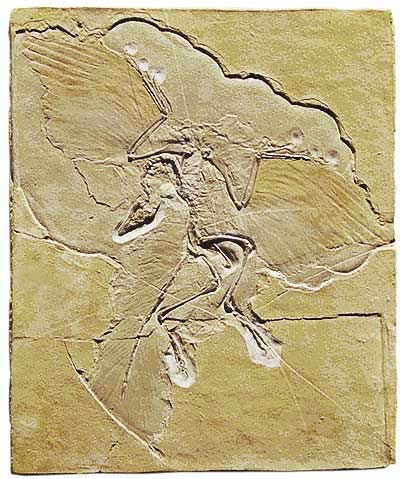 Archaeopteryx lithographica
Museum-quality replica of Archaeopteryx, the first bird, one of the most famous fossils in the world
The Berlin Specimen, Archaeopteryx lithographica (ancient wing)
Age: Late Jurassic
Locality: Solnhofen Limestone, Germany
Donated by: Ray Garton
Museum ID: #292
What has reptilian teeth, a long bony tail, three-clawed fingers on each forearm, and feathers? Archaeopteryx, of course. Sometimes referred to as the first bird, we now understand Archaeopteryx to be part of a group related to the ancestors of modern birds. While Archaeopteryx had true feathers and could fly, the creature was mostly dinosaurian in form.
Only about a dozen specimens of Archaeopteryx have been found to date. Of these, the most famous is on exhibit at the Museum für Naturkunde in Berlin, Germany. Found in the 1870s in Germany's Solnhofen Limestone, this specimen is known as the ''Berlin Specimen,'' and remains the best preserved Archaeopteryx discovered so far. From the claws and feathers on the wings to the teeth in the tiny skull, the Berlin skeleton is a window on bird evolution.
The
WVGES Museum is the only museum in West Virginia displaying such an accurate replica of this famous skeleton. Of the many copies of the Berlin Specimen available, few reflect the original's detail and color as well.
Page last revised January 20, 2022.